How it works

The math, shown. Not a black-box answer.

blankit doesn’t guess the right renewal number with a model. It walks the same Canadian actuarial sequence a credentialled consultant would, on every line that carries claims experience — and shows each step in the report you send back to the carrier.

The workflow

Carrier PDF in, defensible fair premium out.

Three moves, roughly ten minutes. The engine does the actuarial work in the middle — and Rider, the AI guide built into blankit, keeps the rest of the file moving. The same engine is reachable from your own AI assistant if you would rather ask for it than click for it.

01

Upload

Drop in the renewal PDF.

Any carrier format — Sun Life, Manulife, Canada Life, Desjardins, Empire Life, Medavie Blue Cross, GreenShield, RBC, Equitable, Co-operators, regional carriers. blankit extracts the renewal letter, experience pages, and rate calculations into a structured document. Rather not upload? A Slack channel, your firm’s email-in address, or a connected cloud folder all start the same analysis.

02

Analyze

Run the actuarial engine.

Every benefit line — EHC, Dental, Life, Dependent Life, AD&D, Critical Illness, STD, LTD, EAP — is priced on the path that fits it. The result is a defensible counter-number, line-by-line, in carrier-comparable units.

03

Report

Send the firm-branded PDF back.

The output is a renewal challenge report — your firm’s logo, your firm’s colours, your firm’s tone — with executive summary, line-by-line math, and a recommendation the carrier can’t hand-wave away.

The methodology, in full

Five actuarial moves, one defensible number per line.

At the core are five adjustments that turn a carrier’s quoted loss ratio into a defensible one; the full sequence below runs eight. The same logic appears as a footnote on the report PDF, so when the underwriter pushes back, the answer is already on the page.

1

Pool-charge stripping

Isolate the group’s own experience; expose pooled risk. Two layers in Québec.

2

IBNR completion

Load unreported claims — required, never defaulted.

3

Trend to renewal

Project the experience forward to the period being priced.

4

Credibility blend

Weight experience against the carrier’s manual rate.

5

TLR gross-up

Hold the carrier to their own loss-ratio target.

Every step, EHC / Dental

  1. 01

    Strip large claimants, re-add the pool charge

    Individual claimants above the carrier’s own stated pooling threshold are removed from paid claims and replaced with a standard pool charge. This isolates the experience the group is actually responsible for — and exposes how much of the “premium” is really pooled risk the carrier never had to fund.

  2. 02

    Remove the pooling charge from gross premium

    The carrier’s pooling charge comes out of gross premium to reveal net premium — what was actually available to cover group claims. This is the denominator the carrier doesn’t want shown. A Québec group has two pooling layers, not one, and the QIP charge comes out alongside the standard one.

  3. 03

    Complete the claims with IBNR

    Incurred-but-not-reported claims are loaded onto paid claims. For EHC and Dental the IBNR figure is never silently guessed — it comes from the carrier’s own disclosure, your booklet library, or a value you enter. Miss it and the analysis hard-blocks rather than inventing one.

  4. 04

    Compute the real net loss ratio

    Incurred claims ÷ net premium. Materially higher than the carrier-quoted loss ratio, because the denominator dropped and the numerator rose. This is the negotiating number.

  5. 05

    Trend to the renewal midpoint

    The experience period is projected forward to the policy period being priced. When the renewal discloses its own trend assumption, blankit uses it — nothing to argue about.

  6. 06

    Credibility-blend with the carrier’s manual rate

    The square-root rule (Limited Fluctuation Credibility) blends the trended group experience with the carrier’s implied manual rate. Larger groups carry more weight; smaller groups borrow more from the manual.

  7. 07

    Gross up by the carrier’s own target loss ratio

    Health and dental are grossed up by the target loss ratio you set per client from the carrier’s renewal, your booklet library, or Salesforce. Holding the carrier to their own pricing target — not a guessed benchmark — is what makes the position aggressive and defensible.

  8. 08

    Cap at the carrier proposal

    blankit will never recommend paying more than the carrier asked for. The fair premium is the lower of the calculated value and the carrier proposal.

The eight steps above are the EHC and Dental path — the two lines a carrier rates on the group’s own claims, and so the two worth challenging on them. Life, Dependent Life, AD&D and Critical Illness are volume-rated, priced off age and headcount rather than experience; disability and EAP carry no experience to re-rate either. Those lines pass through at the carrier’s proposed premium and are reported as such, rather than being argued with on math that doesn’t apply to them.

Where the numbers come from

Precedence, not a table of hardcoded percentages.

Every input the engine touches follows the same order of authority. The carrier speaks first; your library speaks next; a flagged reference value speaks only when nothing else can.

01

Preferred

The carrier’s disclosed figures

If the renewal states a trend assumption, an IBNR factor, a target loss ratio, or a credibility weighting, blankit uses it exactly — and writes it through to your library and Salesforce, so next year’s file starts from the carrier’s own figure too. Arguing with a number the carrier printed themselves is the strongest position there is.

02

Fallback

Your firm’s booklet library

Where the renewal is silent, the figure comes from the client’s own assumptions — sourced from the booklet library, Salesforce, or a value you enter per client. The number stays specific to the plan, not a market average.

03

Last resort

Flagged platform reference values

Only when neither is available does blankit reach for a platform reference figure — and it flags it as such on the report, so nothing calibrated in-house is ever passed off as carrier-stated.

The two that are never silently defaulted: the target loss ratio and the IBNR factor for EHC and Dental. If neither the carrier nor your library supplies them, the analysis hard-blocks and prompts you — it will not manufacture a figure to keep the pipeline moving.

Provincial mechanics

The Québec adjustments most national tools quietly skip.

A Québec health premium isn’t comparable to an Ontario one. Two distinct pieces of it buy something other than this group’s own claims — and a tool that rates the whole premium as if it were group risk will overstate the loss ratio and understate what the file supports. blankit separates both before the math starts, then puts them back on the fair premium at the end.

RAMQ carve-out

EHC

Québec drug coverage bundles a RAMQ premium into what the carrier bills, but it carries essentially no group claims behind it. blankit takes it out of both the current and proposed premium before rating, prices the experience-rated coverage on its own, then adds RAMQ back as a pass-through — so the totals you compare stay like-for-like.

QIP pooling layer

EHC

Québec groups carry a second pooling charge on top of the standard large-amount layer. Both come out of gross premium to find the net premium actually available for group claims, and both are reconstituted after the target-loss-ratio gross-up — because the carrier's own target prices the net-of-pooling portion only.

When you take it to market

Quotes compared on the terms that hide in the fine print.

When a renewal goes to market instead, carrier quotes are lined up on more than premium. The comparison normalizes the financial terms that decide what a quote really costs — and every carrier’s stated assumptions get their own page in the deliverable, so nothing is compared out of context.

Pooling threshold

Where each carrier’s large-claim protection actually starts — a higher threshold is real risk quietly moved back onto the plan.

Virtual care

Whether telemedicine is bundled or a billable extra, so a “cheaper” quote isn’t just a thinner one.

Health spending accounts

The admin fee each carrier charges on HCSA dollars — a cost that never appears in the premium line.

Critical Illness terms

What the CI benefit actually covers, carrier by carrier, instead of a checkmark in a spreadsheet.

In the product

Where the methodology lives.

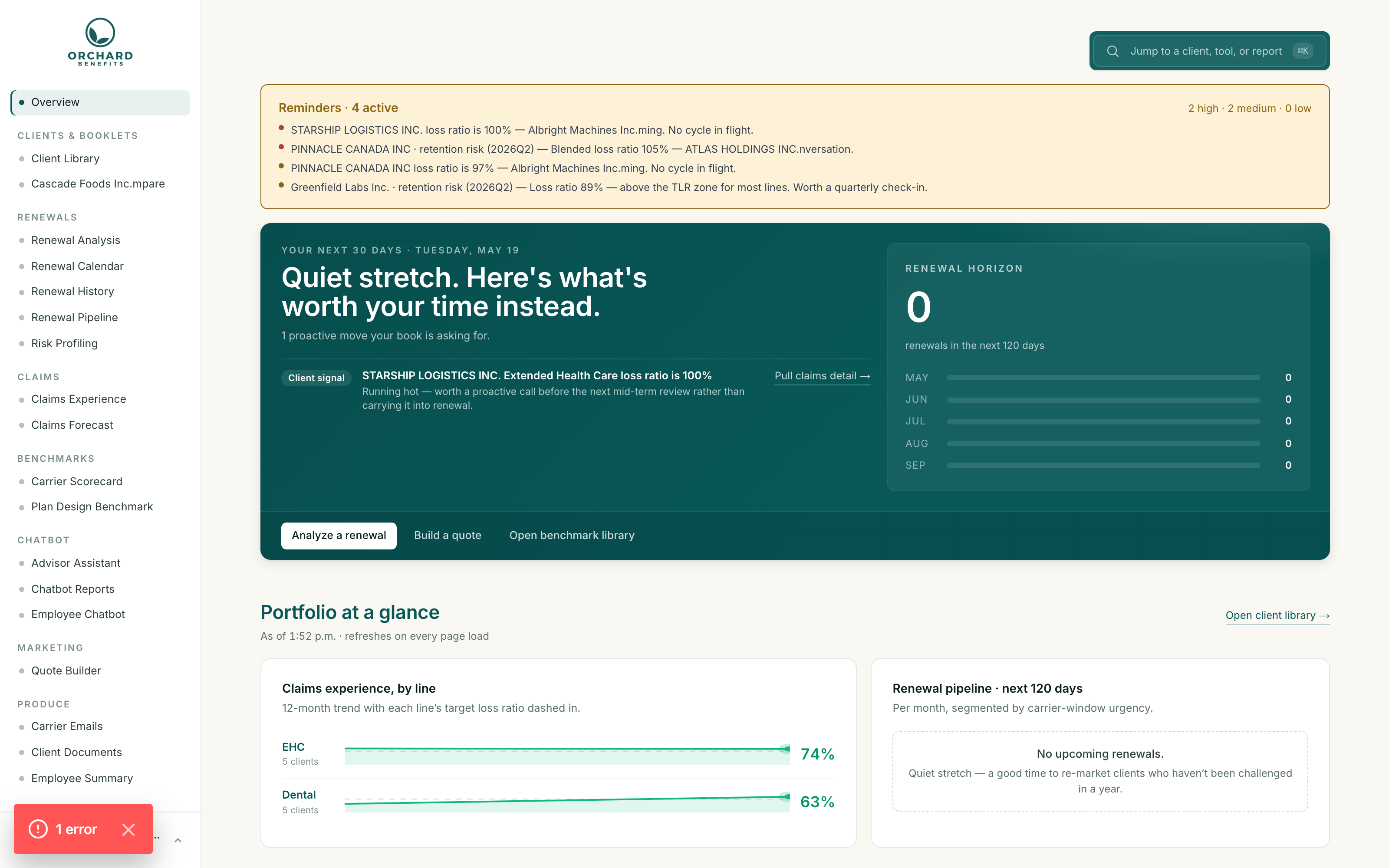
Practice dashboard

Practice dashboard

Renewal pipeline, the Clients hub, claims experience, and benchmarks in one surface.

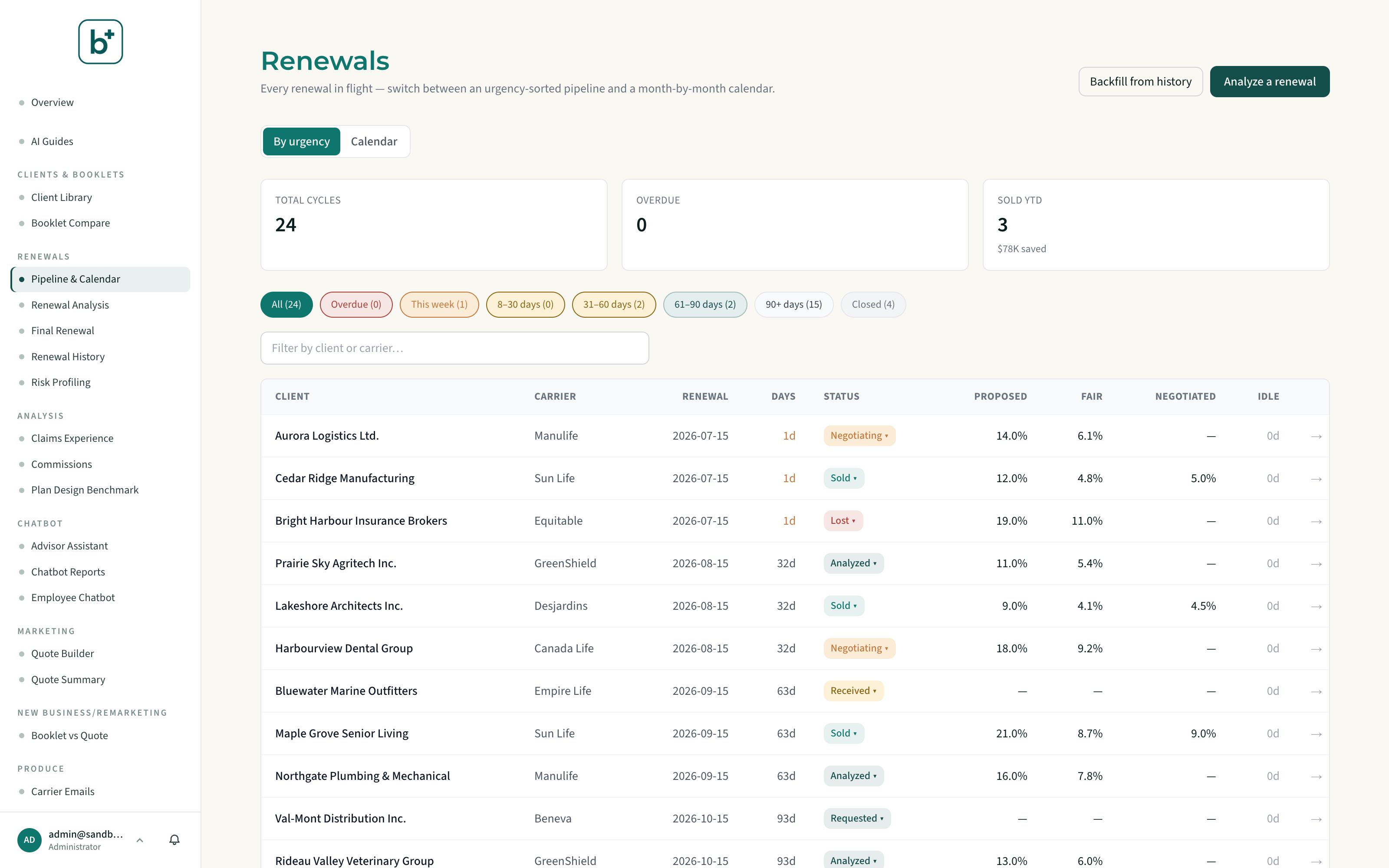
Renewal pipeline

Renewal pipeline

Every renewal in flight, urgency-sorted — proposed, fair, and negotiated increases side by side.

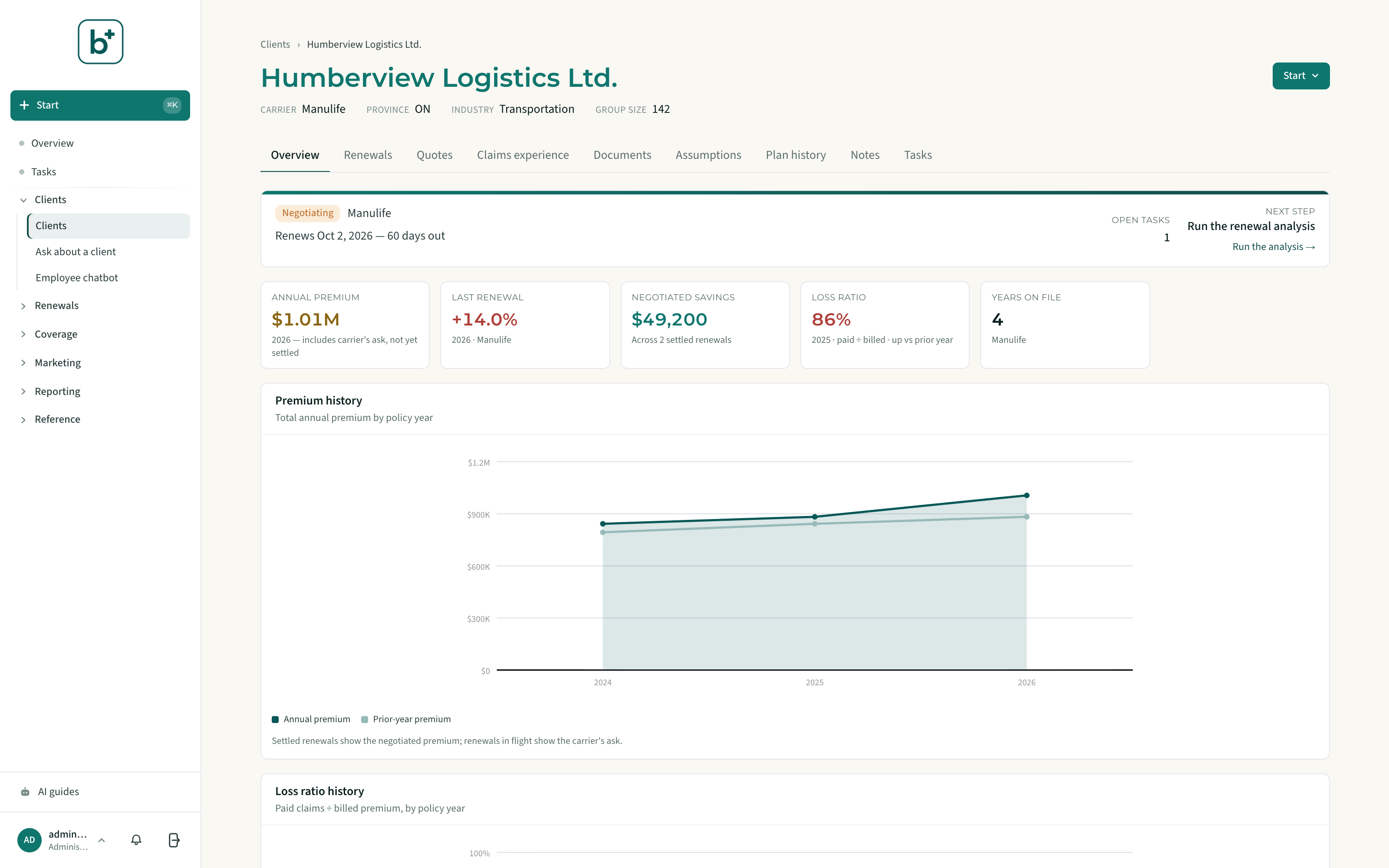
Client dashboard

Client dashboard

Where a group stands at a glance — the renewal in flight, what the plan costs, and the years of premium and claims history behind it.

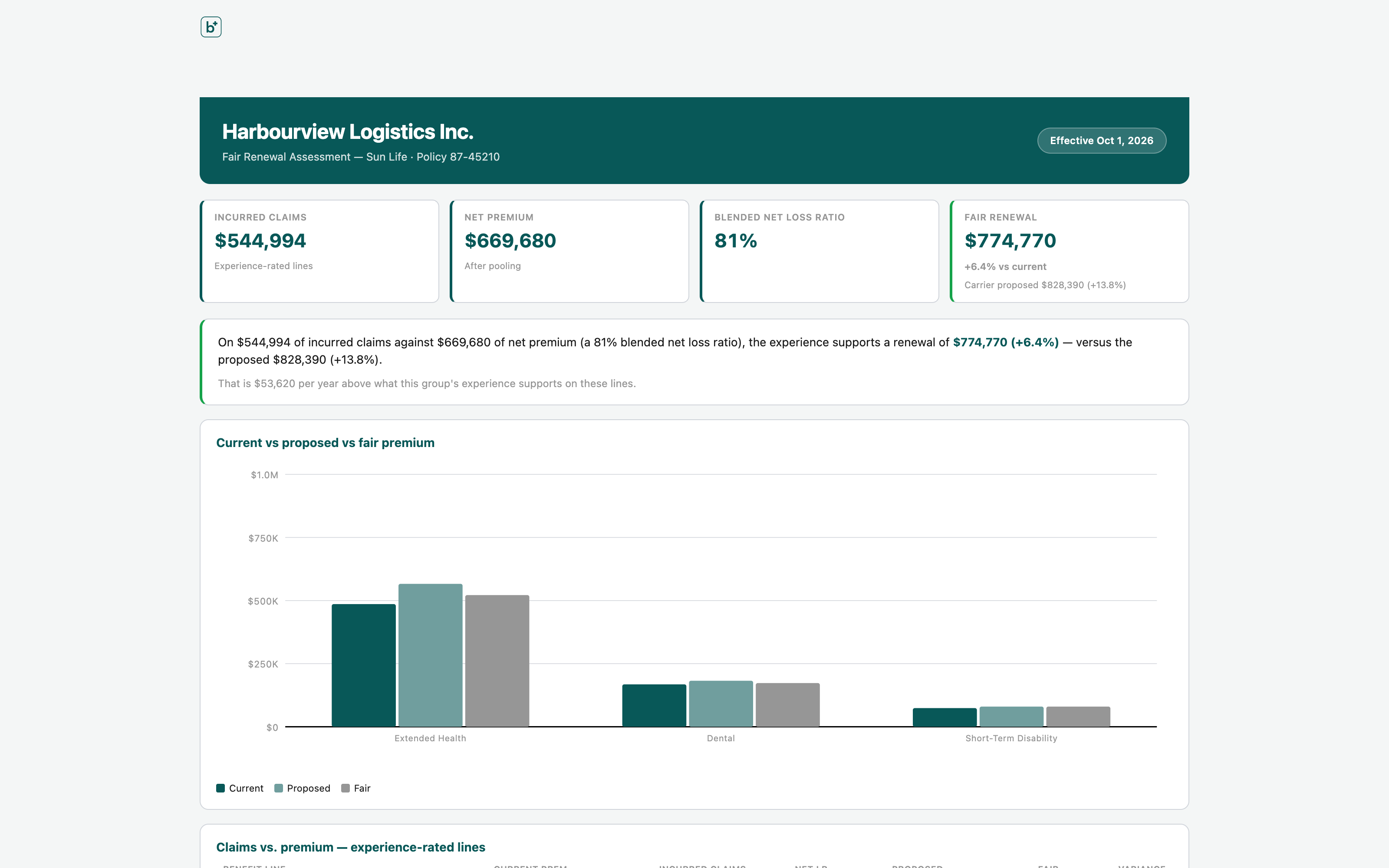
Fair Renewal one-pager

Fair Renewal one-pager

The carrier-facing summary: incurred claims, net premium, and the fair renewal position, stated line by line.

Claims experience report

Claims experience report

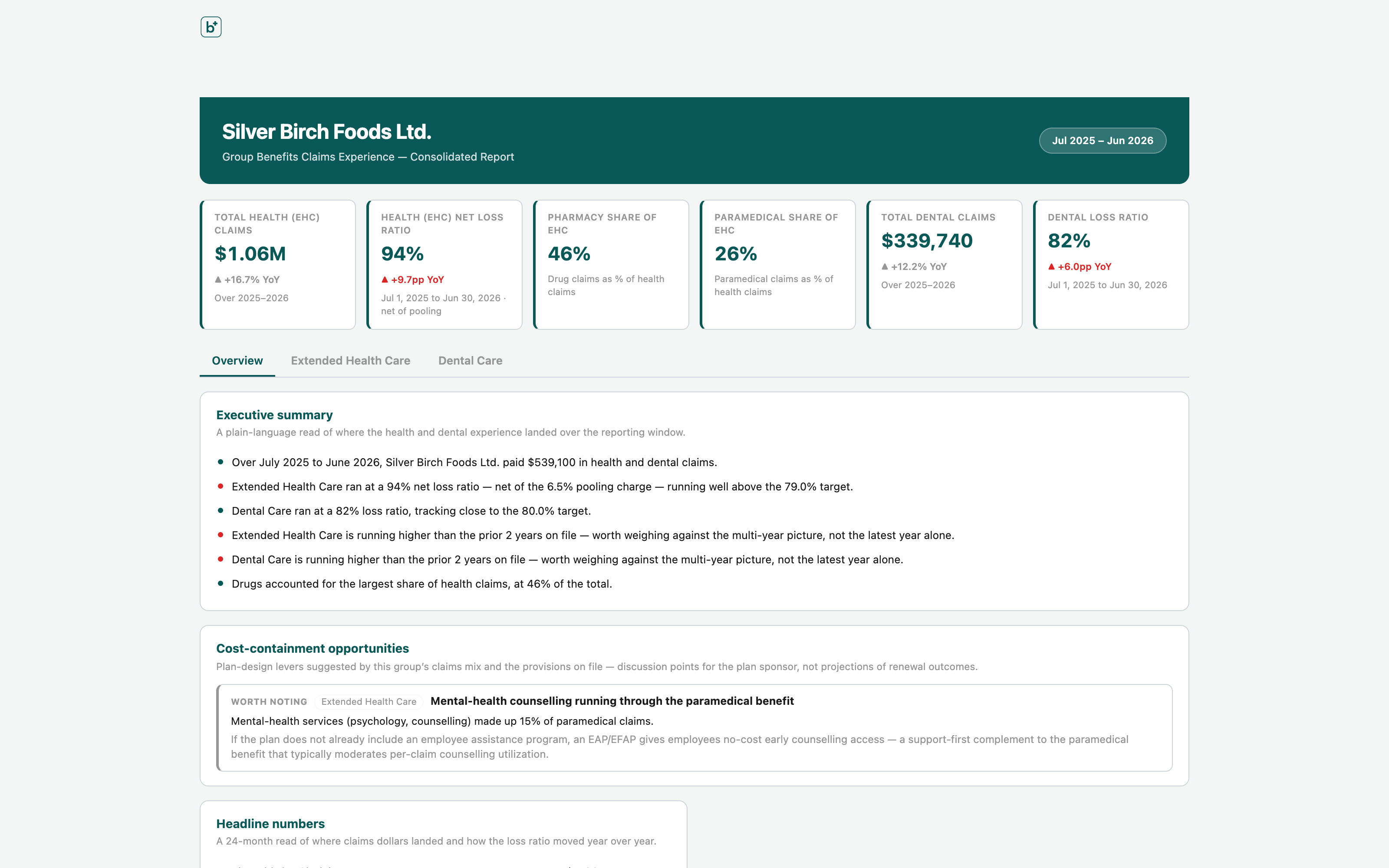
A branded, interactive report that weighs multiple years — loss ratios, claim drivers, and category mix.

Employee benefits chatbot

Employee benefits chatbot

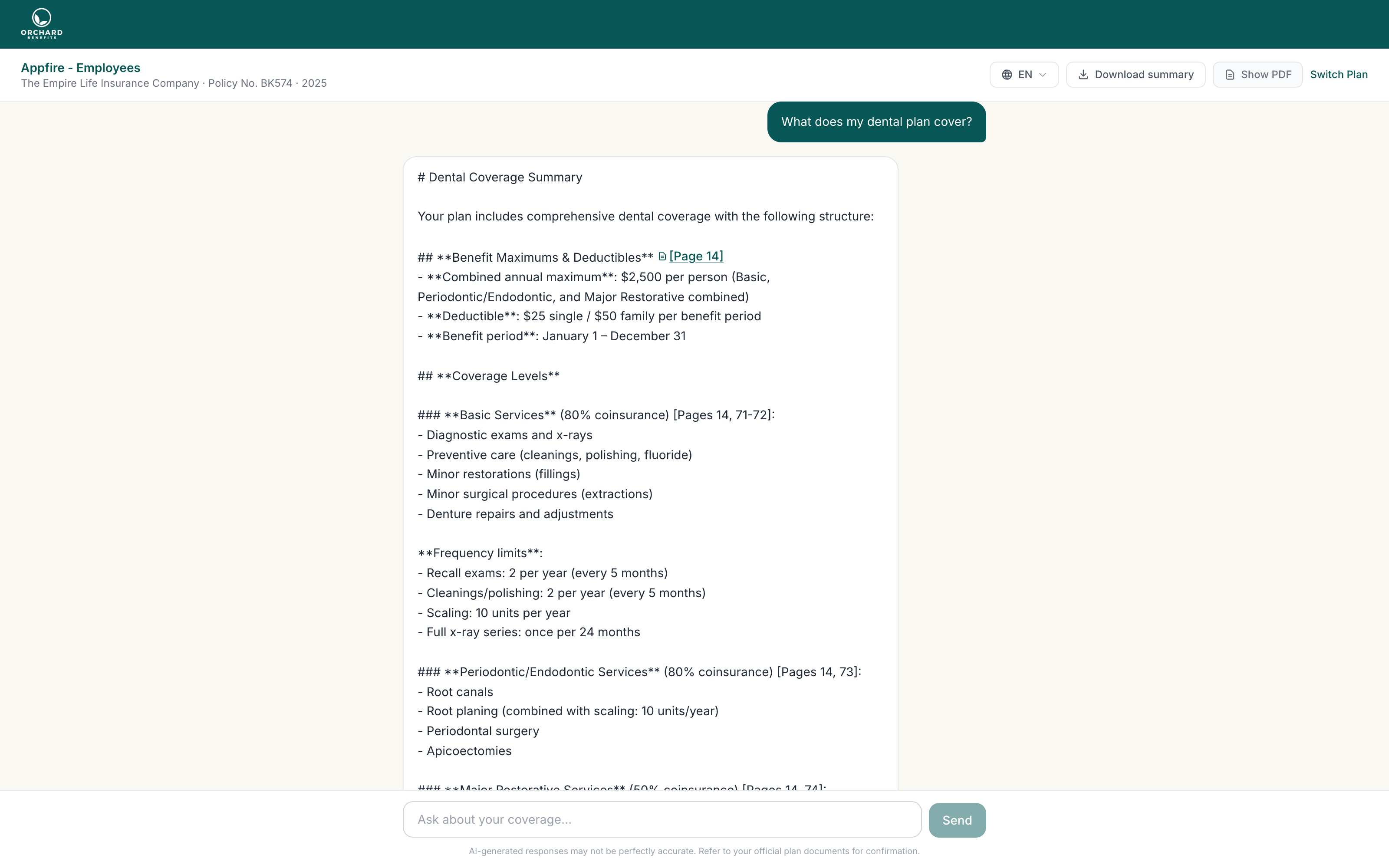
Booklet-grounded Q&A for plan members, white-labelled to the employer.

Critical illness enrolment

Critical illness enrolment

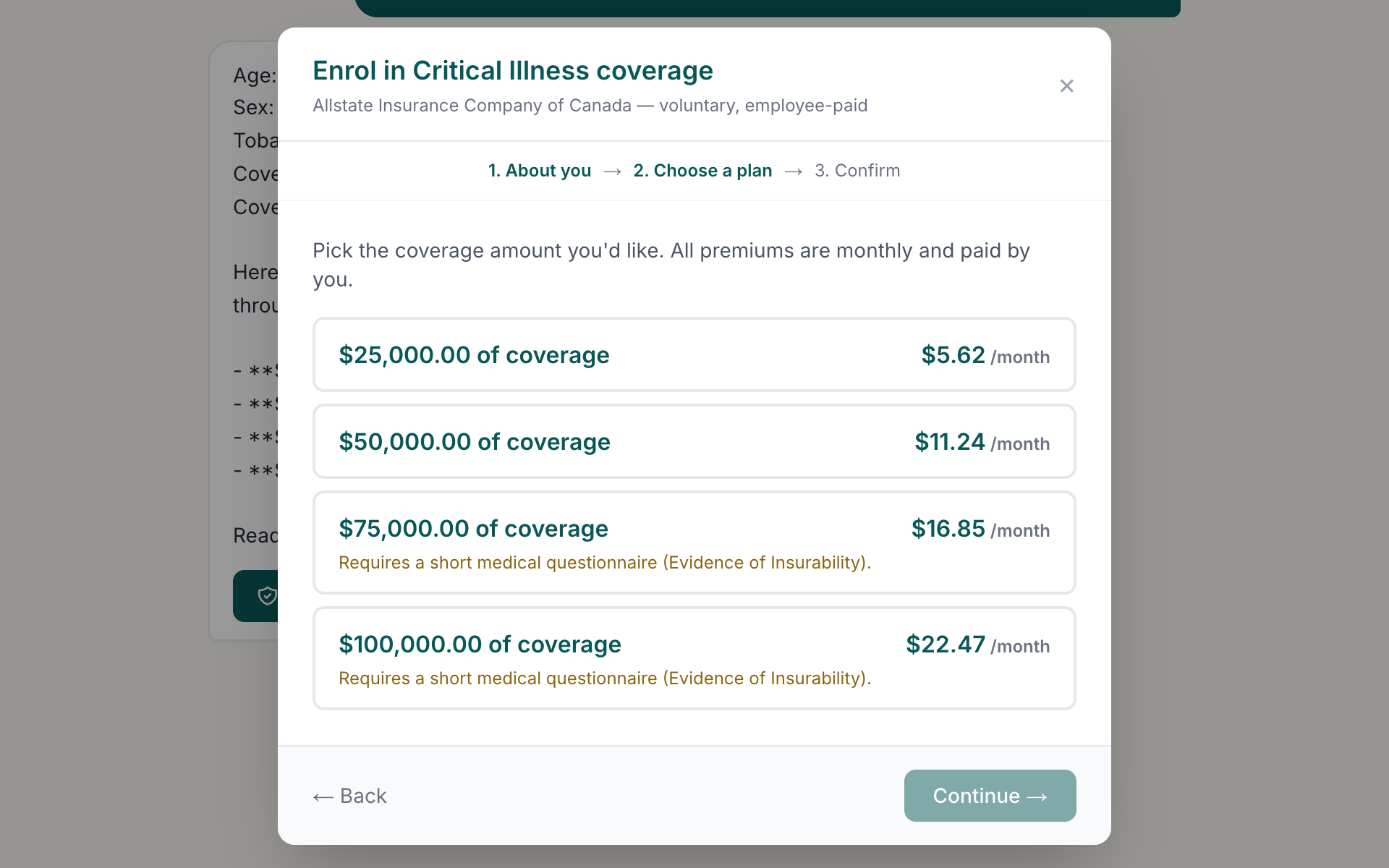
Plan members buy supplemental CI coverage in minutes, with carrier-bound rates.

Support access

What support sees inside your firm — and what stays hidden.

Once a tenant is provisioned, the engineer who built blankit can’t open it the way a senior advisor at your firm can. The day-to-day product is firmId-scoped at the database layer: cross-firm reads aren’t a permission to grant, they aren’t a code path.

The exception is support. When a problem inside your data needs an engineer, the platform admin can start a read-only impersonation session that lasts thirty minutes. The session is two things at once: gated against writes at the edge middleware, and rewritten at the data layer.

Stays visible

  • Carriers
  • Dollars and loss ratios
  • Dates and headcount
  • Benefit lines and provinces
  • The shape of every page

Replaced or redacted

  • Client and contact names → Client-XXXX
  • Emails and phone numbers
  • Document titles and filenames
  • Policy and group numbers
  • Free-text blobs (notes, JSON)

Pseudonyms are deterministic — the same client gets the same code across pages, sessions, and refreshes. That way a support conversation can reference a specific case without exposing identity. Every session start and end is recorded in the audit log under the operator’s identity. See exactly how on the Trust & security page.

A dashboard view during an active read-only impersonation session. Top banner reads 'Read-only impersonation. Signed in as masking-demo@humberlinebenefits.ca (Humberline Benefits) — as chris@blankit.ca. Writes disabled; client PII is masked.' The Your Next 30 Days panel underneath lists Client-AA03 at 88 lives renewing Jul 21, Client-6CE9 at 37 lives renewing Aug 2, Client-D1F8 at 210 lives renewing Aug 14, Client-B6E9 at 53 lives renewing Aug 28, and Client-DA8F at 96 lives renewing Sep 14 — names masked, numbers intact.
Real capture from a live impersonation session. Same pixels every operator sees.
Try it on a live renewal

Pull a real renewal and watch the methodology run.

Reading the sequence and watching it run on a file you already know are different things. Bring your most recent carrier renewal and we’ll step through it on screen — including the places the engine refuses to proceed on a figure the carrier never disclosed.

Try the demoBook a walkthrough