
The carrier already did the math. We check it.
Reprice carrier renewals, take groups to market, report on claims and answer anything about any client — under your firm’s brand, with client data stored in Canada and AI processing that may occur outside it.
Your email sets up the walkthrough — no marketing list, no sharing.
Fair renewal summary
Humberview Manufacturing · renewal, effective 1 Jan
Carrier ask
+16.4%
$565,704 / yr
Fair renewal
+2.1%
$496,206 / yr
Four surfaces do the heavy lifting.
One client record and one brand behind all four.
Reprice any carrier renewal against a defensible fair premium.
Upload the carrier's renewal — PDF, experience workbook or photographed pages. blankit reprices health and dental against the premium the group's own experience supports, counters every other line below the ask, and accepts a line as proposed only where countering would cost the client — then records every counter and revision so the client sees the work, not just the result.
See a sample analysisThe exchange, both sides
Humber Trailworks Ltd. · Health & Dental challenged
- Carrier opened+14.2%
- We countered+4.8%
- Carrier revised+9.1%
- We countered+6.0%
- Settled+6.4%
Positions land on the trail as you work — yours when the challenge goes out, theirs when the reply is forwarded in — and all of it prints in the client’s renewal document.
Take a client — or a group you haven’t signed — to market.
Drop in the census and send each carrier one branded RFQ. Forward the replies and blankit reads the quote and the covering email, flags any carrier off the requested design, and builds a client-ready Benefits Presentation. When a prospect signs, their quote history comes with them.
How marketing a group works| Carrier | Monthly | vs current | Status |
|---|---|---|---|
| Carrier A | $41,120 | −7.9% | Leading |
| Current carrier | $44,650 | — | Renewal |
| Carrier B | $46,010 | +3.0% | Received |
| Carrier C | Declined to quote | Closed | |
The grid stays editable right up to the presentation.
Claims reports that land the same day the data does.
Branded, interactive reports across every year on file — drivers, trends and spend by claim type. Forward the carrier’s report and the finished document lands in your inbox.
How claims reporting worksPaid claims by period
Health · three policy years
Ask anything about any client. Get a cited answer.
Rider reads the booklet, the renewal history and the claims file, answers in English or French with the source attached, and drafts the follow-up.
Meet RiderWhat did we settle Humber Trailworks at last year, and what drove it?
Everything else, quietly handled.
Practice
Pipeline & Calendar
Every renewal on one timeline — due, out to market, waiting on a carrier — and how the whole book renewed.
Benchmarking
Plan Benchmarking
Where a plan sits against your whole library — or peers of the same industry, province or size — benefit by benefit — including who pays each premium — with a gap analysis the client can read.
Pricing check
The Carrier’s Own Formula
Where a carrier prints its loss ratios, target, trend and credibility — or publishes how it rates disability — blankit runs their method on their figures and shows you where the ask departs from it.
Forecasting
Claims Outlook
How long a price holds: the group’s health and dental claims projected forward against the budget each quote leaves.
Comparisons
Claims Mix vs All Plans
Whether a group runs high on massage or low on drugs, against anonymized aggregates from every firm on the platform.
Coverage audits
Booklets, Policies & Audits
Booklets, master policies and amendments in one library. The delivered booklet is checked field by field against the quote and the policy, so a lowered maximum is caught before a claim is.
Plan design
Plan Change Modelling
What a coinsurance step, a paramedical cap or generic substitution would have saved on this group’s own claims — so you know which change to ask the carrier to price. Their prices come back onto the renewal’s option list and a one-page cost containment sheet for the meeting.
Drug costs
Top Drugs & Savings Cards
Every drug on the carrier’s top-cost list, with its DIN and a cost-management option to review — a generic, a biosimilar, patient assistance. The same list read as chronic vs acute spend and by condition, with claimants and cost per claimant per DIN, drug claims by province when the carrier splits them, and what each province’s drug plan means where the employees live, in English or French. A drug on the innoviCares or RxHelp ONE covered list is flagged in the renewal report, the claims report and the client dashboard, checked against each program’s own published list and dated. And a one-page employee handout on the programs your firm approves, under your logo and the sponsor’s, in English or French (French first for a Quebec client), with no claims data on it. Use innoviCares and RxHelp ONE as provided, make your own copy, or leave either out.
Disability
EI Premium Reduction
Every renewal with short-term disability shows what Service Canada’s EI Premium Reduction Program is worth this year, and whether the plan qualifies.
Funding
ASO Funding Comparison
Insured versus self-funded health and dental, side by side — claims, fees, stop-loss and tax — with the claims level where the two break even. Already self-funded? The renewal reviews the fee, budget, reserves and stop-loss instead, the fee is set against what the same administrator charges your other groups, and the administrator’s statements — uploaded in bulk or forwarded by email — show how the plan is doing since the switch.
Guides
Workflow Guides
Announcements, plan amendments, onboarding — Rider pre-fills each step and drafts what the client receives: announcement emails and FAQs, a client-ready marketing document as PDF and Word.
Clients
Client Dashboard
One screen per group: the renewal in flight, what the plan costs, how claims are trending, which carriers hold the premium and every year of history. The whole book exports to Excel or CSV in one click, and every client’s documents download as a zip.
Client records
Province, Filled In For You
Read off the carrier renewal and checked against the public registers it mirrors — Corporations Canada and the Registraire des entreprises du Québec. Confirm it once and nothing changes it again.
Onboarding
Renewal History Import
Taking over a book? Import past renewals — ask, outcome, savings — so day one starts with real history, and blankit learns from every one. Each client’s years add up: the compounded yearly increase they paid, what the carriers asked for, and what negotiating saved. Brand-new groups start from the carrier’s set-up rates, with the first renewal already on the pipeline.
Mid-year
Coverage Changes
A client wants vision mid-year: blankit asks the incumbent to price it, chases the reply and turns it into a branded pricing summary.
How coverage changes workCommissions
Commission Reconciliation
Set expected rates — a flat %, a fixed dollar amount or a crown scale — forward the carrier’s statement, and see shortfalls, missing groups, which carriers are paying less than your book over the year, your collection rate, what your book will pay you over the next 12 months and in which month each carrier pays it, a heads-up when a renewal moves a group into another crown-scale band, what you will owe each co-broker ahead of time, and what your book is worth at the multiple you are quoted. Split a group’s commission with a co-broker or an advisor in your firm, track what you have paid them and email each their statement, export the year to Excel or email it to your accountant, and give your bookkeeper a commissions-only login.
Accounting
QuickBooks & Xero
Your commissions, ready for your books. Pick QuickBooks Online or Xero and a month, and blankit builds the import file: one invoice per carrier statement, a line for each group, every line marked tax exempt. When the carrier’s deposit lands in your bank feed, match it to the invoice and the commission is recorded once, against the right groups. Share commission with outside co-brokers? What you owe them comes as bills, ready to match against each payment. Connect QuickBooks Online once and press Send instead: the invoices go straight into your books, and a month already there is never sent twice. The setup steps sit right beside the button, and Rider or your own AI can hand you the file too.
Plus risk profiling, carrier scorecards, carrier bulletins, a task board, multi-document report bundles, webhooks, and optional sync with the CRM you already use.
Everything the practice knows, in one place.
Booklets, renewals, claims, quotes, commissions and tasks all live on one record — nobody digs through a folder for what happened last year. Every step taken on a client is logged there as it happens, and where there is an obvious next step, a task for it opens on its own and closes once it is done.
Rider works the record, not just reads it.
Proposed in the chat, applied only when you approve.
- Draft the challenge email for this renewal
- What pooling charge did the carrier load?
- Rebuild the one-pager with the round-2 counter
- Which clients renew in the next 90 days?
- Summarize the dental experience, last three years
- Start a mid-year vision quote for this client
What leaves your firm
What your clients and carriers actually open.
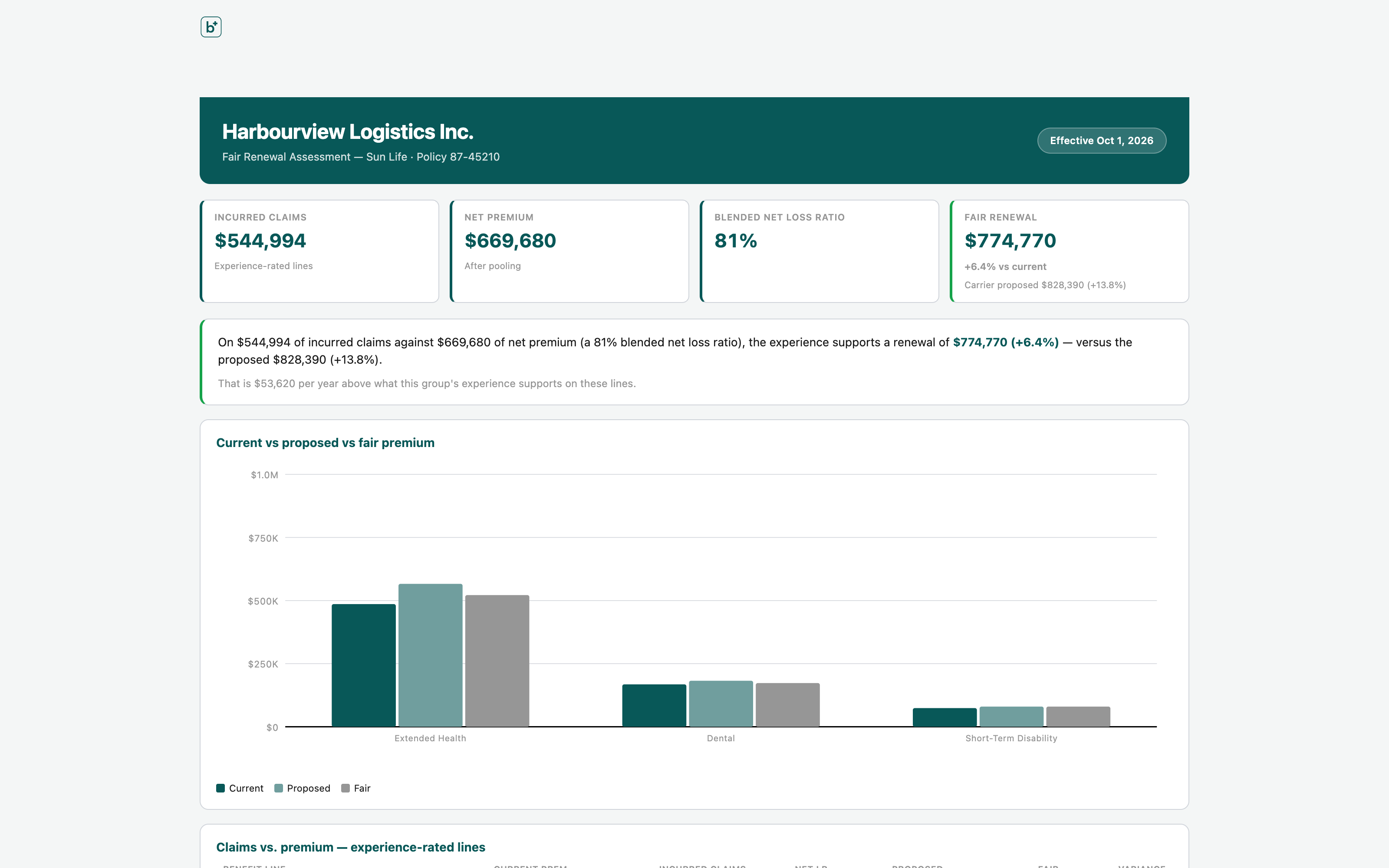
Fair Renewal Summary
The two-page carrier-facing summary: incurred claims, net premium, and the fair renewal position for health, dental and STD.
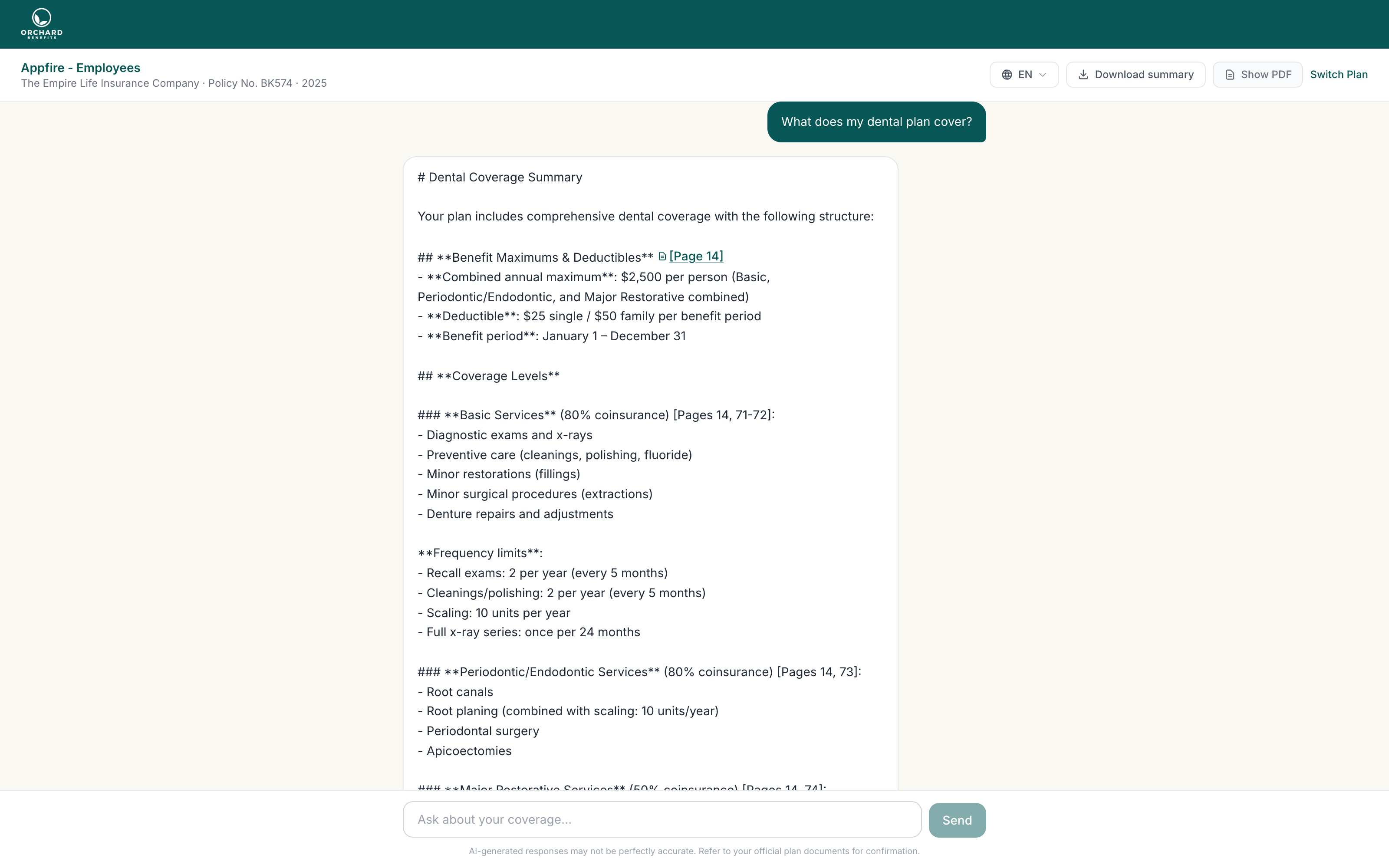
Employee chatbot
Booklet-grounded Q&A for plan members, white-labelled to the employer.
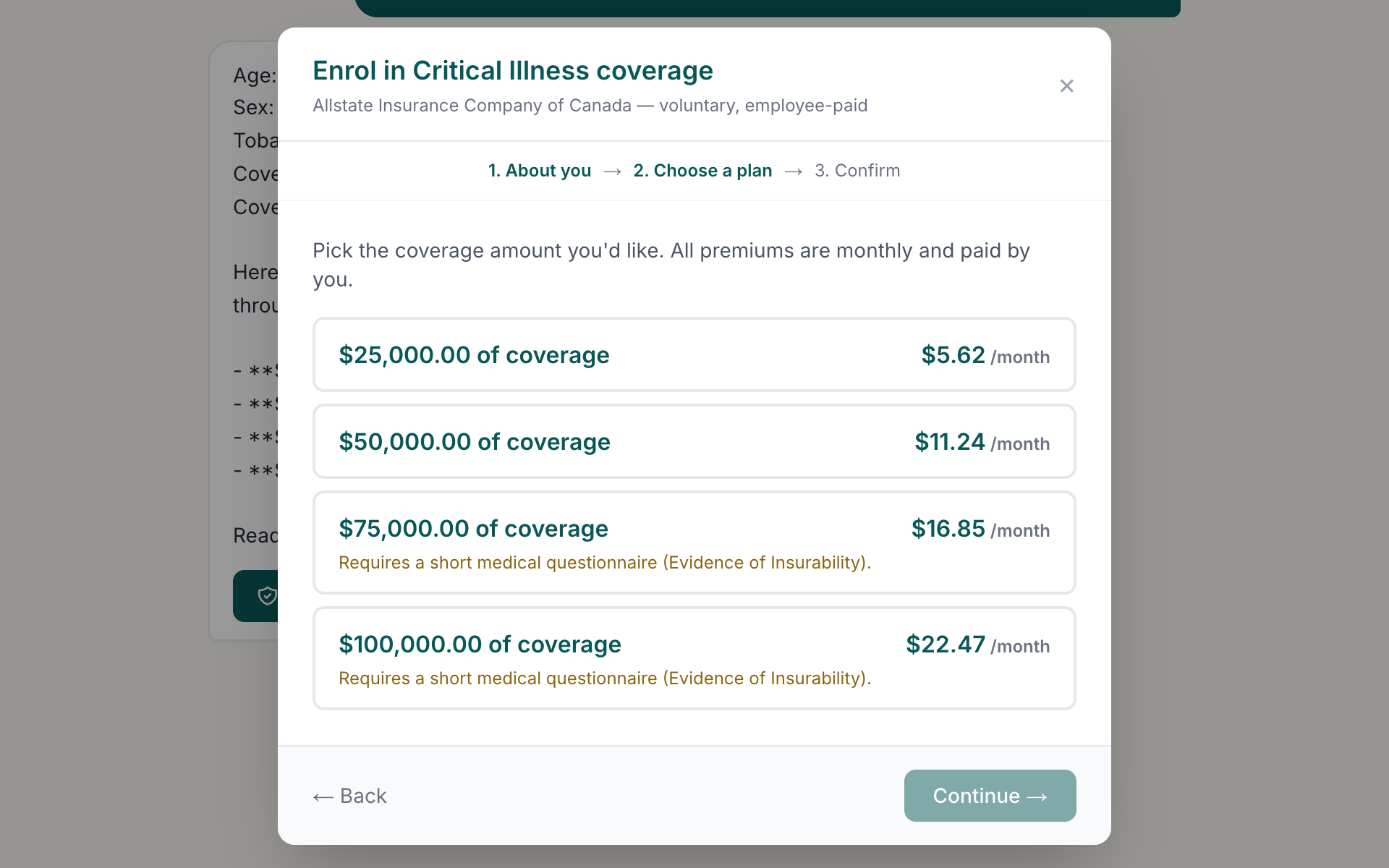
Critical illness enrolment
Plan members buy supplemental CI coverage in minutes, with carrier-bound rates.
The carrier sends one number. We rebuild it.
blankit rebuilds the carrier’s health and dental premium from the group’s own claims with recognized Canadian actuarial methods, counters every other line below the ask, and shows every step in the report you hand back.
When the carrier’s ask holds up, your analysis says so — and the counter is labelled as a negotiating position rather than dressed as a claims finding. A tool that finds every renewal excessive isn’t an analysis.
See the full actuarial walkFour corrections to the carrier’s number
Pool out the large claims
Take out the catastrophic claims — the pooling charge already pays for that risk.
Complete and trend the claims
Add claims incurred but not yet reported, then project to the new plan year.
Blend for credibility
Weight the group’s experience against the manual rate by how much data there is. The manual starts from last year’s rate, not this year’s ask.
Hold to the carrier’s own target
Gross up to the carrier’s own target loss ratio — not a benchmark we invented.
Nothing silently defaults.
Target loss ratio and IBNR are never defaulted — if one is missing, blankit asks. Anything synthesized is footnoted, and any adjustment you make is shown to the carrier with its reason.
Send the renewal from wherever you already are.
Not a notification feed — the actual work. Send a carrier document from the channel or inbox you already use, and ask about any client while you’re there.
Send
Drop it in Slack or Teams, forward it to your firm’s intake address, or send it from Outlook. Claims reports saved to a watched Google Drive folder are picked up too.
Read
blankit reads it and runs the engine — exactly as if you had uploaded it.
Reply
The analysis comes back to you, linked to the draft in your pipeline.
Or ask the chatbot you already have open.
Connect your own AI chatbot and ask it “what should Humber Freight actually be paying?” It runs the same engine as every other surface, on your real book — not a chatbot guessing at benefits.
What it can touch
You grant the permissions
Read-only by default. Saving, changing assumptions and starting a quote are each off until you turn them on.
It cannot contact anyone
Nothing it can do sends email to a carrier or a client.
Everything is written down
Every request is audit-logged, and revoking the key stops it at once.
Three steps, nothing to install: create a key, paste it in, ask.
The booklet you already read, as a site their staff can.
The plan design you extracted for the renewal becomes a plain-language site for the client’s employees, with Paige, the employee chatbot, for anything the page doesn’t answer. Rebuild from a new booklet and every page updates.
- Built from the booklet
- Every page comes from the plan design already extracted — nothing to write.
- Thirteen languages
- English and French automatically, plus eleven more.
- Behind an access code
- On your domain, in your colours, with your chatbot (Paige, or the name you give it) on every page.
A Quebec group’s site can’t go live without French or have it removed, and a client corrected to Quebec after launch gets French back automatically. How microsites work.
Coverage your clients’ staff can buy without leaving the chat.
Switch on the Blue Cross Life critical illness offer and Paige quotes it, takes the application in the chat, and tells the employee the cover is portable — it follows them if they leave their employer. Completed applications go to Blue Cross Life with you copied. Add your firm’s own optional benefits beside it, offered to every client or only the ones you choose — employees ask to enrol in the chat, and each request waits on your task board until you mark it done and tell them.
- They ask Paige
- A starter question in the chatbot, in all thirteen languages.
- $25k and $50k are Guaranteed Issue
- No health questions — done when the conversation is.
- $75k and $100k are signed first
- A health questionnaire goes out for e-signature first.
Off until you turn it on.
Your name on everything. blankit stays invisible.
- Fully white-labelled. Reports, one-pagers, quote summaries, portals and the email blankit sends for you all carry your firm’s name, logo and colours.
- Your name in the From line too. Verify your sending domain and mail goes out as your firm. Until then, blankit is named once in the header so it isn’t junked.
- One advisor or a hundred. Licensed per advisor, so an independent, a brokerage or an MGA works the same way — and an MGA can put its advisor firms on under its own account, each with its own brand.
2026 Renewal Position
Extended Health & Dental · Policy #GRP-40218
Prepared for
Humberview Manufacturing
Prepared by
Orchard Benefits
Effective
1 Jan 2026
▲ your logo, name & colours — every document, letter-perfect
9lines
Every benefit line the plan carries reaches the renewal report and executive summary — including the ones the renewal left unchanged.
20yrs +
Of front-line advisor experience behind the methodology.
Stored in Canada. Isolated per firm.
Data storage
Stored in ca-central-1
Carrier PDFs, extracted data, generated documents and backups are stored in AWS Montreal.
AI processing
Claude, through Amazon Bedrock
Documents are read by Anthropic’s Claude through Amazon Bedrock. Requests enter AWS in Montreal, and AWS may process them outside Canada, including in the United States, under the AWS Data Processing Addendum. blankit runs Amazon Bedrock with data retention set to “none” (zero data retention). AWS states that in this mode no request or response data is written to durable storage or shared with the model provider. Storage stays in Canada. Census and roster files are read in code, so no AI sees them.
Isolation
Your own database
Every firm gets its own database, storage bucket and encryption key — not rows in a shared table. A cross-firm read has no route to happen.
Access control
Passkeys & enforced 2FA
Passkeys, authenticator apps or email codes, with a second factor enforceable firm-wide. Limit each team member to the work they do — renewals, marketing, coverage changes or claims.
Accountability
Built to be audited
A hash-chained audit trail makes altered or deleted history detectable, and nightly checks flag stored figures that don’t add up. Designed against a SOC 2 control set.
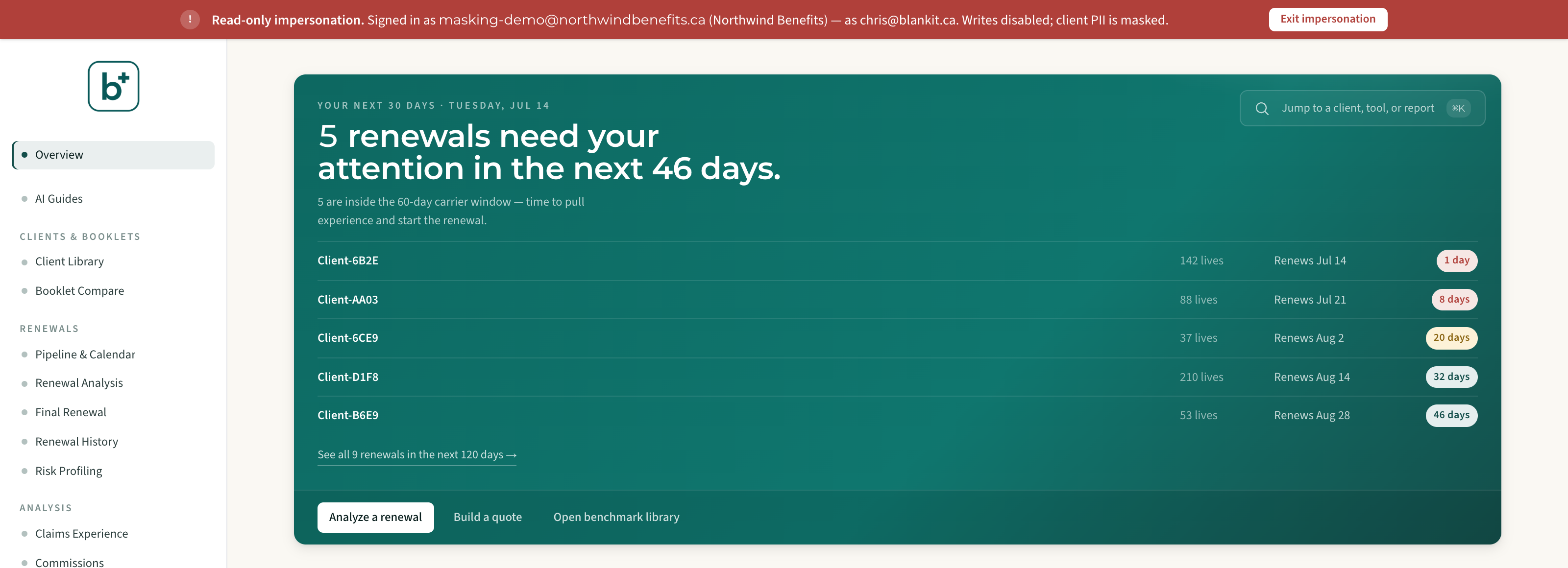
Even we can't see your client list.
When our team steps in to fix a problem, the session is read-only and every client name is replaced by a fixed code — Client-A4F2, never Acme Corporation. We can trace the numbers; we never see who your clients are. More on the Trust & security page.
The things advisors ask first.
Still wondering about something? Talk to us — a real person answers.
Do I need Salesforce or any specific CRM?
No. Everything works without one. If you keep Salesforce, HubSpot, Dynamics 365 or Zoho, blankit can read your clients and renewal dates from it — read-only by default.
Which carriers and documents does it handle?
Every Canadian carrier’s renewals, experience reports, quotes, booklets and commission statements — as PDFs, workbooks, scans or photos. The covering email is read too, and where it disagrees with the report the difference is flagged.
Can an MGA or a multi-advisor brokerage license it?
Yes — for its own team, on one licence agreement under its own brand. Each advisor gets their own seat and book; the firm sees across all of them. Each renewal shows who is working it, and the Renewals board filters to one person’s — or your own. Tasks work the same way: every task belongs to someone, each person’s Tasks page opens on their own to-do list, and whoever a colleague hands a task to gets an email. An MGA can also bring its advisor firms on under its account: each firm gets its own brand, documents and client book, kept separate from every other firm, and the MGA’s own team does the work — signing in once and working across as many firms as they need. One list shows every renewal and task coming due across the group, and the team gets it by email each Monday. A group benchmark puts the firms side by side — renewal outcomes by firm and by carrier against the wider blankit market, each firm’s health and dental loss ratio, and each firm’s claims mix against the group’s — downloadable as Excel or CSV. The MGA adds and removes firms itself and sees what each one uses.

“I spent 20+ years challenging carrier renewals for my own clients. blankit is the tool I built to do it properly — now any advisor, brokerage or MGA can run it under their own name.”
Chris Gory · Founder & Principal Advisor, Orchard Benefits
Run it on one of your own clients.
Bring one client — a renewal, a marketing exercise, a claims file. We’ll run it through blankit and show you the documents your client would see, in your firm’s branding.